
Is PRP Worth Adding to Microneedling?
The framing people arrive with is "PRP facial or microneedling." That's not the actual choice, and getting the framing right makes the decision much easier.
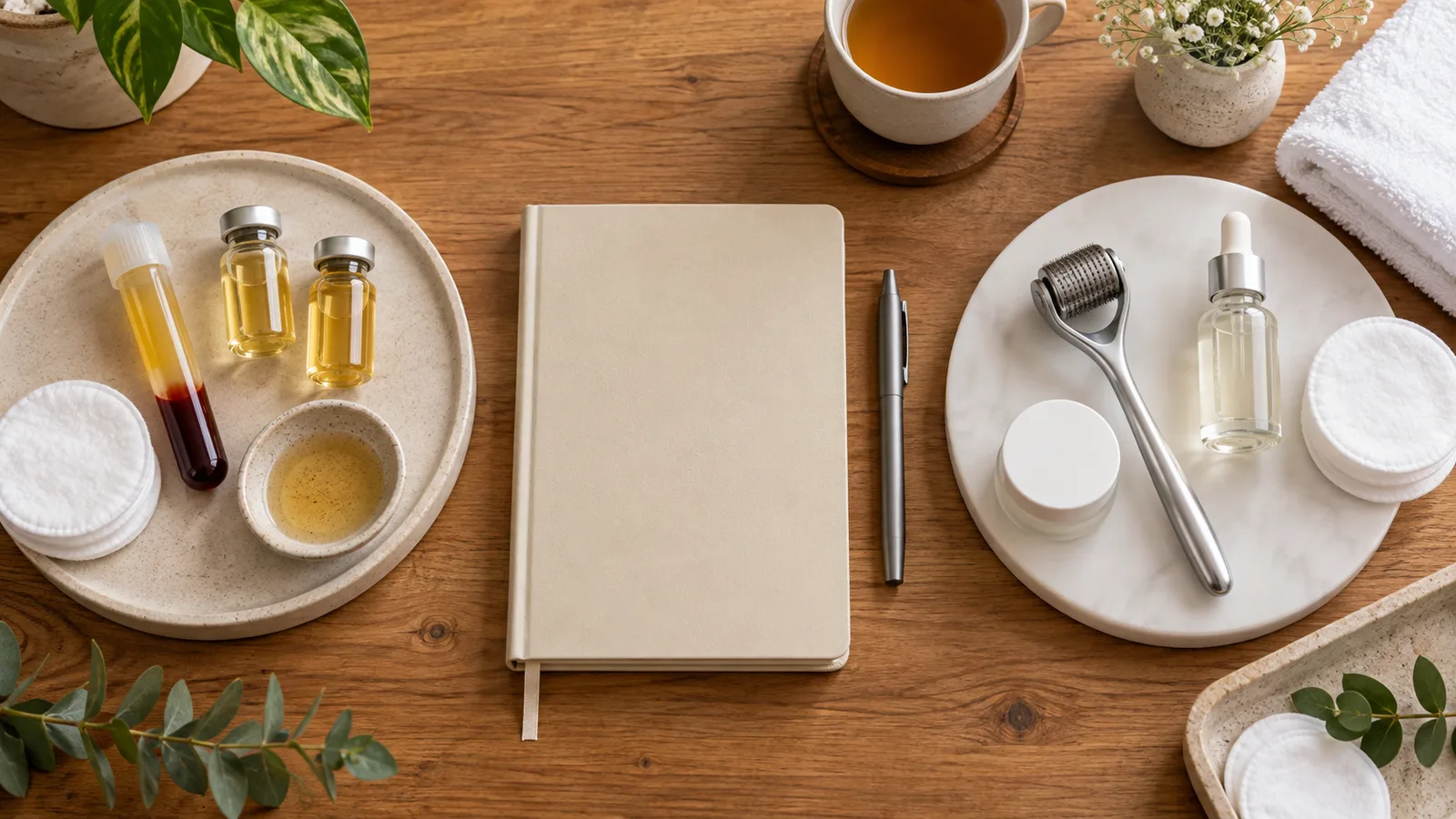
A PRP facial is microneedling with a step added. Blood comes out of your arm, goes into a centrifuge, and part of what comes back gets applied while your skin is being needled so it can get past the surface. Take the PRP away and you still have a complete treatment. Take the microneedling away and there's no meaningful way to deliver the PRP.
So the real question is narrower and more useful: does the extra step earn what it adds to the bill?
Why this is hard to answer honestly
You'd want a clean comparison. Same person, same skin, one side treated with the add-on and one without, with nobody knowing which was which.
Split-face studies of roughly that design do exist, and they generally lean positive for the add-on on texture and on the appearance of shallow scarring. But the field has a real problem underneath: preparation methods differ enormously between practices. Spin speed, spin time, the separation kit, how much of which fraction gets used. Two treatments with the same name on the menu can be materially different products.
That makes the published evidence harder to apply to the specific appointment you're being offered than the marketing implies. It doesn't make the treatment fake. It means the honest summary is "probably some added benefit, size uncertain, depends partly on how they prepare it."
There's also an expectation problem that nobody can design away. You watched them take your blood. You know which treatment you got. Everyone involved is rooting for the more elaborate version to have been worth it.
Where the add-on has the best case
Acne scarring, particularly rolling or boxcar scars. This is where the split-face work is most encouraging and where practitioners who use it tend to be most confident. If scarring is the reason you're booking, the add-on is worth considering seriously.
Skin that has healed slowly or unremarkably from previous needling. If a plain series underdelivered, adding a step before abandoning the approach is a reasonable next move.
When you're doing a full series anyway. The add-on compounds across sessions, so it makes more sense inside a committed course than as a one-off experiment.
Where I'd skip it
General glow and fine lines. Plain microneedling does most of this work, and the marginal gain is the hardest to detect in exactly the situation where it costs the most per unit of benefit.
A single trial session. One PRP facial tells you very little and costs substantially more than one plain session. If you're testing whether needling suits you at all, test with the cheaper version.
When the budget is fixed and the choice is quality versus quantity. This is the trade-off nobody frames properly. The same money often buys either a shorter course with the add-on or a longer course without it. For most complaints, more sessions of the plain treatment is the better buy, because the number of sessions is doing more work than the add-on is.
If needles in your arm are a genuine problem for you. That's a real consideration and it shouldn't be brushed aside. The plain treatment is a complete treatment.
What the add-on doesn't change
It doesn't shorten the series. You're still looking at roughly three sessions spaced four to six weeks apart.
It doesn't shorten recovery. The needling is what your skin is recovering from, and that's identical either way. A couple of days looking windburned, then a rougher-textured stretch.
It doesn't change candidacy. If something about your skin means microneedling isn't appropriate right now, adding PRP doesn't rescue it.
And it doesn't replace the pigment, sun, and habit work that determines most of the result on most faces.
Questions that settle it
Ask what the difference in price is per session, and then multiply by three. The per-session gap sounds small and the course gap usually doesn't.
Ask how they prepare it, in plain terms. You're not auditing the centrifuge. You're checking whether the answer is specific or vague, because vague means it's a menu item rather than a practice.
Ask what they'd expect the add-on to contribute for your particular complaint. "It helps with everything" is not an answer. "For rolling scars I'd want it, for general texture I'd spend the money on a fourth session" is an answer, and it's the kind that tells you the provider is thinking about your money as well as their menu.
Ask whether they'd start plain and add it later if the response is modest. A provider who's comfortable with that is comfortable being wrong, which is a good sign.
Getting a straight answer locally
This is a question where two competent providers can reasonably disagree, and I'd rather you got the disagreement out loud than took mine.
Plenty of readers here widen the search over into Hoboken for this and barely register the trip. If you'd rather stay close, the city's The Official Website of City of Union City, NJ - Home will at least confirm a business exists and is trading, and neighborhood coverage in Union City, NJ News and Union City Patch.am - What you need to know today: Free Newsletter, Local News, Events & Calendar will at least tell you what's opened and closed lately. None of that tells you anything about clinical judgment.
One scheduling note. A three-session course plus a check is four trips over about three months, so if your calendar runs on a term at somewhere like Stevens Institute of Technology, map all four onto it before you pay for the first.
Start plain, do the full series, and add the step when there's a specific reason to.
Before a school-run morning gets spent on a consultation, it helps to read how a Hoboken clinic lays out its PRP appointments at myethosspa.com/services/prp-facial/, so the questions you bring are sharper.